
The most expensive green building failures in California don’t come from windows or cavity insulation — they come from an overlooked tile backer board that breaks your thermal model and violates IAQ rules.
Tile Backer Pro low-VOC XPS backer boards solve hidden compliance risks for passive house, LEED, seismic renovation and modular bathroom projects across the West Coast.
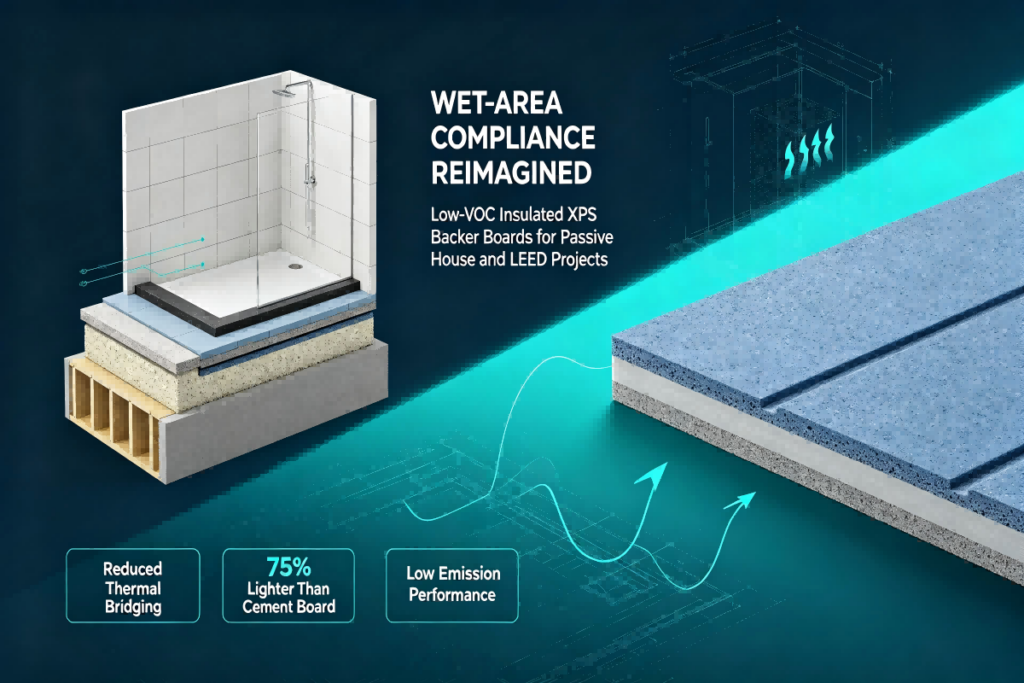
Introduction: California Title 24’s Hidden Compliance Trap — Why Standard Backer Boards Fail Green Inspections
A Bay Area passive house project spends six months iterating energy models, passes all structural and seismic reviews, and satisfies every LEED credit requirement — yet fails final certification. The setback stems not from window performance or cavity insulation, but from conventional cement backer boards that introduce uncalculated thermal bridging and elevate formaldehyde levels beyond California’s stringent indoor air quality thresholds.
Across California and the West Coast, this overlooked compliance barrier derails high-end green building projects, delays schedules, and erodes project profit margins. California enforces some of North America’s most rigorous building codes: strict low-emission material regulations under CARB ATCM, mandatory seismic resilience standards in the California Building Code (CBC), and Title 24 energy provisions that drive new construction toward net-zero performance. Local green building mandates such as CALGreen further raise the bar for material health, energy efficiency and structural sustainability.
Most design and construction teams default to traditional cementitious backer units for wet-area tile substrates. These boards are heavy, porous, and manufactured with binders and adhesives that risk pushing VOC and formaldehyde emissions over regulatory limits. Critically, backer boards are rarely classified as a high-priority compliance component. Specified late in the design phase and treated as a generic commodity, they frequently become a last-minute failure point — delaying occupancy, invalidating green building certifications, and triggering costly full-wall teardowns and reworks.
This is no minor material detail. For passive house designers, LEED consultants, and luxury residential developers, improper backer board selection can undermine months of precision design and compliance modeling.
The Scene-by-Scene Compliance Crisis: How Standard Backer Boards Derail West Coast Green Building Projects
Conventional cement and gypsum backer boards do not create universal flaws. Instead, they trigger unique, project-specific risks that directly impact core stakeholders across the West Coast green building sector.
Northern California & Pacific Northwest Passive House / Net-Zero Residences
Audience: Passive house certified designers, energy modelers, custom residential architects
For teams pursuing PHI / PHIUS certification and net-zero energy targets, standard cement backer boards negate months of precise energy modeling work.
- Thermal bridging disrupts calibrated energy models: After 3–6 months of iterative wall assembly simulation, rigid cement backer boards introduce unaccounted linear thermal bridging. This elevates overall wall U-values beyond passive house thresholds, requiring full energy model overhauls and delaying certification submissions by months.
- Airtightness failures prompt repeated blower door testing: Rigid cement boards feature inconsistent seam integrity and minor structural movement during installation, breaking the continuous air barrier required for passive house certification. Failed blower door tests demand repeated sealing rework, with labor costs far exceeding material expenses.
- VOC deficiencies downgrade certification tiers: High-emission binders in conventional boards lead to substandard indoor air quality test results. Projects targeting top-tier passive house certification often drop to basic energy-efficient status, eliminating the project’s market premium and damaging designers’ professional reputations.
Southern California Luxury Custom Homes
Audience: High-end residential developers, premium interior designers, luxury general contractors
For multi-million-dollar custom homes in Los Angeles, Orange County, and San Diego, material performance and air quality compliance are inseparable from brand credibility and client trust.
- Client project rejection due to IAQ violations: High-net-worth homeowners have zero tolerance for elevated formaldehyde and VOC emissions. Post-occupancy air quality testing frequently links poor indoor air quality to standard cement backer boards, leading clients to reject project finalization. Delays can incur six-figure penalty costs and eliminate valuable referral business within luxury real estate circles.
- Seismic reinforcement cost inflation: Luxury homes feature extensive wet areas, including outdoor showers, spa suites, and dual master bathrooms. The excessive dead load of cement boards forces structural engineers to specify upgraded studs and additional seismic bracing, increasing structural costs by 15–20% and reducing project margins.
- Compromised occupant experience: Exterior bathroom walls without integrated thermal insulation remain cold year-round. This noticeable temperature inconsistency creates persistent post-occupancy complaints, undermining the premium living experience marketed for luxury properties.
Statewide Commercial & Municipal LEED Projects
Audience: LEED accreditation consultants, public sector EPCs, infrastructure project managers
For public buildings, educational facilities, and commercial offices pursuing LEED certification, backer board compliance failures trigger financial, contractual, and reputational risks.
- Certification downgrades eliminate green incentives: VOC emissions from conventional cement boards reduce Indoor Environmental Quality (EQ) credit scores. Projects targeting LEED Platinum often drop to Gold status, disqualifying properties from state and municipal green building incentives and activating contractual certification penalty clauses.
- Title 24 energy code non-compliance: Unmitigated thermal bridging raises wall assembly U-values beyond Title 24 limits, resulting in failed energy inspections and delayed building occupancy. For commercial tenants and public facilities, daily operational revenue losses vastly outweigh substrate material costs.
- Prolonged seismic submittal reviews: The heavy dead load of cement boards requires additional structural calculations and supplemental bracing documentation for public project approval. This extends plan review cycles by 2–3 months and disrupts overall project timelines.
West Coast Modular & Prefabricated Bathroom Pods
Audience: Modular construction EPCs, bathroom pod factory engineering leads, supply chain directors
For the fast-growing off-site construction industry, traditional heavy backer boards negate the core speed, cost, and logistical advantages of prefabricated bathroom pods.
- Weight overruns compromise transportation efficiency: Cement board weight pushes fully assembled bathroom pods over standard highway load limits, forcing teams to split shipments and conduct on-site reassembly. This eliminates factory production cost savings and increases shipping expenses by an estimated 40% or more.
- Poor dimensional accuracy increases factory rework: Field-cut cement boards have loose dimensional tolerances that fail to match precision-engineered pod frames, driving routine assembly rework rates of 15% and disrupting factory production cycles.
- Wet-cure processes bottleneck production: Conventional cement board installations require liquid waterproofing and extended cure times, requiring dedicated stationary curing space on production floors. This doubles per-unit production cycles and limits overall factory output.
Tile Backer Pro: The Compliance-First Backer Board Built for West Coast Green Building
Tile Backer Pro low-VOC XPS backer boards are engineered at the core to resolve California’s top wet-area compliance failures. Unlike traditional boards that rely on aftermarket surface coatings, our closed-cell XPS substrate delivers low emissions, ultra-light weight, and superior thermal performance as inherent material properties.
Backed by ICC-ES PMG Listing (No. PMG-1804) for complete tileable shower systems — compliant with 2009–2024 IPC, IRC, UPC and National Plumbing Code of Canada — and CE marked under CPR Regulation 305/2011/EU AVCP System 4, our systems are manufactured under ISO 9001, ISO 14001 and ISO 45001 certified management systems for consistent, auditable quality control.
| Parameter | Standard Cement Backer Board (1/2″) | Basic XPS Backer Board | Tile Backer Pro |
|---|---|---|---|
| Weight (psf) | ~2.5–3.0 lbs/ft² | ~0.8–1.0 lbs/ft² | 0.6–0.9 lbs/ft² (by thickness) |
| Formaldehyde Emissions | High binder emission risk | Variable, often untested | 0.018 mg/(m²·h) tested, meets CDPH v1.2 / CARB limits |
| Thermal Performance | No insulation value, strong thermal bridge | Basic insulation, inconsistent seams | Continuous closed-cell insulation, ≤0.030 W/m·K per ASTM C518 |
| Flame Retardance | Non-combustible but heavy | Variable, often unrated | Engineered to meet ASTM E84 Class A flame spread criteria; GB 8624 B1 certified |
| Installation Method | Wet waterproofing required, long cure time | Semi-wet, partial sealing required | Fully dry mechanical install, zero waterproofing membrane cure wait time |
Ultra-Low VOC Emissions: Meets Strict California IAQ Limits
Tile Backer Pro features zero added formaldehyde in its formulation. Third-party laboratory testing per GB 50325 records a formaldehyde emission level of just 0.018 mg/(m²·h), well within the stringent thresholds of CDPH Standard Method v1.2 (CA Section 01350) and CARB ATCM Phase 2 requirements. Total volatile organic compound (TVOC) emissions are capped at ≤1.0 mg/(m²·h), supporting premium indoor air quality standards.
These performance characteristics deliver tangible compliance benefits:
- Emission test data fully supports LEED v4.1 EQ Credit: Low-Emitting Materials submittal packages
- Aligns with California Title 24 indoor air quality compliance pathways for new and renovated construction
- Delivers low-emission performance ideal for luxury residences, passive houses, and occupancy-sensitive facilities
- Eliminates last-minute IAQ compliance failures that delay final building occupancy approval
When integrated into full high-performance wall assemblies, the product may also contribute to Energy & Atmosphere and Innovation credits, subject to project-specific certification review. For LEED consultants and indoor air quality specialists, Tile Backer Pro eliminates one of the most unpredictable specification variables in wet-area wall design.
Lightweight Seismic-Ready Design: Up to 75% Lighter Than Standard Cement Board
Tile Backer Pro panels weigh 0.6 lbs/ft² for 6mm thicknesses and approximately 0.9 lbs/ft² for standard 12mm panels — 65%–75% lighter than conventional 1/2-inch cement backer boards, eliminating excess dead load from all wet-wall assemblies.
This lightweight design delivers critical advantages for California’s strict seismic building codes:
- Significantly reduces wall dead load, simplifying structural engineering calculations and plan review processes
- Minimizes or eliminates supplementary stud bracing and structural reinforcement required to offset substrate weight (verified by licensed structural engineers)
- Optimized for mid-rise multifamily buildings and modular construction with strict weight budget constraints
- Lower wall mass reduces seismic inertial forces, enhancing overall structural resilience during seismic events
For structural engineers and modular EPCs, this substantial weight reduction streamlines design workflows, cuts structural material expenses, and lowers on-site installation labor costs.
Closed-Cell Core Reduces Thermal Bridging for Title 24 & Net-Zero
Tile Backer Pro’s 100% closed-cell XPS core adds continuous, uniform insulation to wet-wall assemblies, drastically mitigating the substrate-level thermal bridging that invalidates traditional energy model calculations.
Tested per the ASTM C518 steady-state thermal transmission standard, the XPS core achieves a thermal conductivity of ≤0.030 W/m·K at 25°C. Engineered as a high-performance passive house shower substrate, the panel integrates continuous thermal insulation and a reinforced waterproof bonding layer into a single, compact component, delivering measurable energy performance improvements:
- Optimizes overall wall U-values to meet strict California Title 24 energy code requirements
- Sustains passive house thermal continuity and airtightness targets without additional insulation layers
- Reduces long-term HVAC loads to advance residential and commercial net-zero energy goals
- Simplifies wall assembly design by combining structural substrate, waterproofing, and insulation in one panel
In a typical 2×4 steel stud exterior wall with R-13 cavity insulation, adding 12mm Tile Backer Pro delivers an incremental R-value of ~0.71 ft²·°F·h/Btu (Rsi 0.125) at the wet area substrate, reducing overall wall U-value by approximately 8–10% and eliminating the localized thermal penalty of an uninsulated cement backer board. This continuous insulation contribution directly supports Title 24 energy code compliance and passive house thermal continuity requirements without adding wall depth.
For fire safety compliance, Tile Backer Pro holds a GB 8624 B1 flame-retardant rating, engineered to meet ASTM E84 Class A flame spread criteria. Full fire performance test data is available to support California Building Code reviews for interior foam plastic insulation applications.
For passive house designers and energy modelers, the product transforms a traditional thermal liability into a code-compliant thermal asset, resolving core pain points across all West Coast green building project types.
Prefab & Modular Ready: Factory Consistency That Accelerates Production
Tailored for the West Coast’s fast-growing modular and off-site construction market, Tile Backer Pro is manufactured under strict factory-controlled conditions with standardized dimensional tolerances, supporting CNC precision processing and automated assembly line workflows.
This factory-grade consistency drives measurable production and logistical improvements:
- Reduced transportation costs: 65%–75% weight savings keep fully assembled bathroom pods within highway load limits, eliminating costly split shipments and on-site reassembly, with up to 40% lower per-unit logistics expenses.
- Near-zero assembly rework: Consistent panel dimensions match automated production precision, cutting rework rates and stabilizing factory takt time and output capacity.
- Faster production cycles: Fully dry mechanical installation requires no waterproofing membrane cure wait time, eliminating stationary curing stations and reducing per-pod manufacturing cycle time by an estimated 50% or more.
- Safer factory operations: Dust-free cutting eliminates crystalline silica exposure risks, simplifying jobsite safety compliance compared to cement board fabrication.
For modular EPCs and off-site construction teams, Tile Backer Pro delivers dual value: full West Coast green building regulatory compliance and significant factory production efficiency gains.
Take the Next Step
If you’re preparing project specs, green building submittals or modular production plans and need verified performance documents, technical data sheets and full certification records, get in touch with our specialist team directly. We’ll provide customized supporting materials matching your project type, with all test reports and certification files ready for your design review and code approval.
Technical Boundary Conditions
Formaldehyde and TVOC emission data is derived from third-party laboratory testing per GB 50325. Actual on-site indoor air quality varies based on full wall assembly composition, building ventilation rates, and environmental conditions.
Flame retardance performance is certified GB 8624 B1; alignment with ASTM E84 Class A criteria is based on engineered material performance. All installations must comply with California Building Code requirements for foam plastic insulation, verified by a licensed design professional.
Seismic weight reduction metrics are calculated against industry-standard 1/2-inch cement backer boards. All structural and seismic design must be completed by a licensed structural engineer in full compliance with California building codes.
Thermal performance values are based on ASTM C518 laboratory testing. Final wall assembly U-values and Title 24 compliance depend on full project construction details, including stud type, cavity insulation, and exterior cladding systems.
The “zero waterproofing membrane cure wait time” claim refers exclusively to the elimination of liquid waterproofing membrane curing waiting periods, as compared to traditional wet-install cement backer board systems. Tile setting mortars, grouts, and joint sealants must be installed per their respective manufacturer cure time specifications.
LEED and passive house certification eligibility is subject to independent project review and complete documentation submission. This article does not guarantee certification approval.
ICC-ES PMG listing applies exclusively to complete Tile Backer Pro tileable shower systems per Listing No. PMG-1804.
This article serves as technical reference material only and does not constitute engineering warranty or guaranteed field performance results.
About Tile Backer Pro
Tile Backer Pro manufactures high-performance XPS tile backer boards and fully integrated waterproof shower systems for residential, commercial, and green building construction. Specializing in code-compliant, lightweight, energy-efficient wet-area solutions, the brand serves architects, interior designers, real estate developers and EPC contractors across California and the entire West Coast green building market.