
100+ annual freeze-thaw cycles across the Great Lakes region turn standard cement backer boards into powder in 3–5 years — and the damage is invisible until tiles fall off the wall.
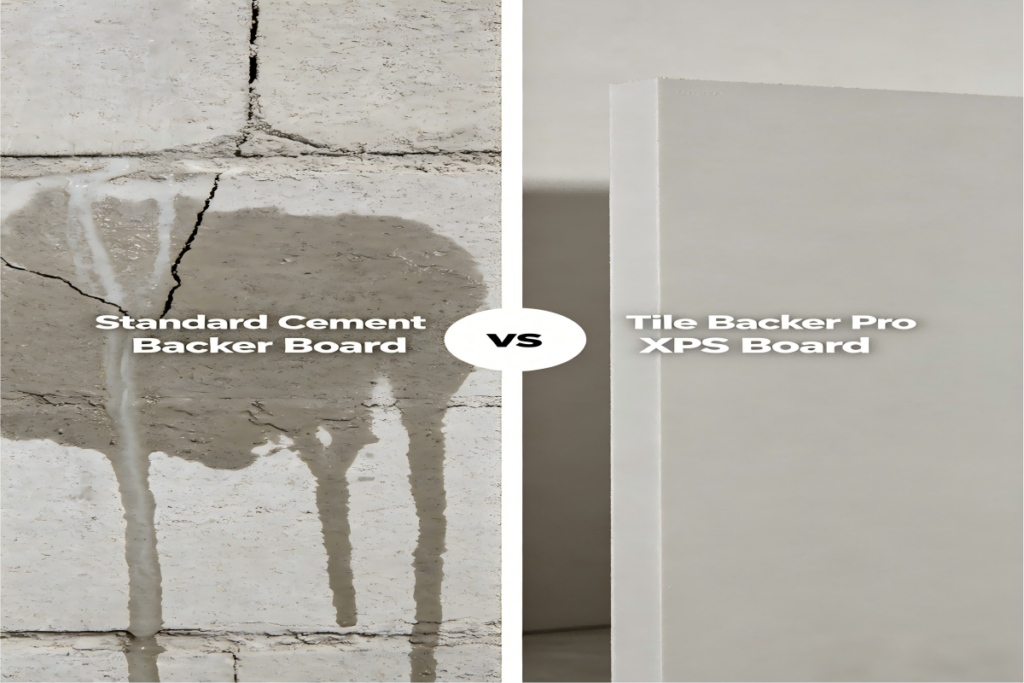
1.Surviving 100+ Freeze-Thaw Cycles: XPS Backer Boards for Great Lakes Cold Climate Wet Areas
After three winters, the tiles in a Chicago high-rise bathroom start to sound hollow. By the fifth winter, they are falling off the wall. This is not an isolated construction defect — it is the predictable outcome of 100+ annual freeze-thaw cycles across the Great Lakes region, acting on a porous cement backer board that was never engineered for this climate.
From Upstate New York to northern Ohio and Michigan, the Great Lakes region faces one of North America’s harshest building environments: repeated temperature swings across the freezing point, paired with persistent lake-effect humidity. For wet area tile installations — bathrooms, showers, locker rooms and pool decks — this climate acts as a slow-motion demolition machine.
Most projects still specify standard cementitious backer units (CBUs) as the default substrate. These rigid, porous boards pass initial inspection, but they carry a fatal physical flaw: they absorb moisture. Water seeps through grout lines, shower steam, condensation and tiny gaps in surface waterproofing. When temperatures drop below freezing, that trapped water expands by ~9% as it turns to ice, prying the board apart from the inside out.
After just two to three winter cycles, micro-cracks form. By year three to five, the core powders, tiles delaminate, and water penetrates deep into the wall framing. By the time damage is visible, the entire wet wall assembly requires full demolition. This is not an installation error — it is a material physics problem. And it is why wet area renovations in cold climates consistently turn into costly repeat repairs.
2. The Scene-by-Scene Pain: How Freeze-Thaw Destruction Plays Out Across Every Project Type
Freeze-thaw damage does not look the same everywhere. Depending on building type, ownership structure and usage intensity, it creates very different financial, operational and safety risks for contractors, property managers and municipal operators.
2.1 High-Rise Multi-Family Apartments: Hidden Decay and Multiplier Repair Costs
For general contractors, property managers and multifamily owners, high-rise wet areas represent the highest-volume and highest-liability freeze-thaw risk scenario.
Concealed progressive failure is the core issue. Cement backer boards in showers and bathrooms slowly absorb moisture through grout lines, pipe penetrations and minor membrane gaps. Every winter freeze cycle expands internal micro-cracks gradually. By the third winter, widespread tile hollowing and loosening occurs; on upper floors, falling tiles create serious falling-object liability, with all responsibility falling on building owners and original contractors.
Exterior-facing wet walls also suffer severe thermal bridging issues. With indoor-outdoor temperature differentials exceeding 40°C year-round, standard porous backer boards offer no insulation, causing persistent cavity condensation. Steel studs rust internally and wood framing rots silently, compromising wall structural integrity long before visible signs appear.
High-rise rework carries extreme cost magnification. Repairs require construction elevator access, full indoor containment and vertical waste hauling, making per-unit demolition and rebuild costs 3–5 times higher than ground-floor projects. Large-scale freeze-thaw failures often exhaust warranty funds and trigger withheld project retention payments.
Operationally, winter maintenance workloads surge by 300% annually. Property teams are trapped in a cyclic repair loop, while seasonal winter labor premiums drastically increase long-term facility operating costs.
2.2 Commercial Public Wet Areas: Downtime Costs Dwarf Repair Bills
For hotels, fitness centers, natatoriums and commercial office buildings, freeze-thaw damage’s greatest impact is not material replacement cost — it is revenue loss, compliance violations and brand damage.
Commercial wet areas face triple stress from high occupancy, constant humidity and seasonal freeze-thaw cycles, cutting the already short service life of cement backer boards in half. Most public wet wall systems begin grout cracking and tile lifting in just 2–3 years.
Frost heave creates uneven floor and wall surfaces, leading to significant slip-and-fall hazards. Combined with chlorinated water corrosion in pool and spa facilities, these defects trigger OSHA workplace safety violations, ADA accessibility non-compliance and costly personal injury claims.
Persistent thermal bridging condensation fosters hidden mold growth inside wall cavities. For hospitality, healthcare and high-end commercial properties, mold issues damage indoor air quality, revoke industry certifications and destroy brand reputation.
Commercial facilities only have narrow off-season windows for renovation. Winter construction delays often force damaged wet areas to remain out of service or functionally compromised for an entire additional year, creating sustained revenue loss and negative user experience.
2.3 Historic and Existing Building Retrofits: Tight Budgets and Zero Margin for Error
Renovation contractors and historic building managers face the thinnest profit margins and highest construction risks in freeze-thaw prone zones, with no tolerance for material failure.
Aged building substrates are uneven, poorly sealed and full of thermal bridge points. When standard cement boards absorb moisture and frost heave, structural displacement is amplified by irregular wall surfaces, resulting in 40% higher tile delamination rates compared to new construction.
Legacy walls retain residual moisture that standard porous backer boards cannot block. Freeze-thaw cycling accelerates vapor migration, causing persistent efflorescence, wall dampness and indoor mold growth, triggering resident health complaints and project rework.
Historic preservation regulations restrict full wall demolition and structural modification. Rotting wood framing and corroded components cannot be fully replaced, trapping project teams in an unsolvable cycle of hidden degradation and limited remediation.
Most retrofit projects are scheduled for fall and winter off-seasons to minimize building disruption. Traditional wet waterproofing membranes require 4 hours of curing at room temperature but stretch to 12+ hours in near-freezing conditions, doubling project timelines and triggering contractual late-delivery penalties that erase project profits.
2.4 Municipal and Public Infrastructure: Permanent Budget Black Holes
Public works departments and municipal facility managers face fixed annual capital budgets, making recurring freeze-thaw failures a long-term financial and administrative burden.
Semi-exposed public restrooms, transit station wet areas and community facility showers are directly exposed to snow, rain and road de-icing salts. Standard cement backer boards fully powder and crack in just 1–2 years, far failing to meet the 5–10 year design life required for municipal public projects.
De-icing brine and meltwater penetrate porous board cores, accelerating internal fastener corrosion and structural breakdown during freeze-thaw cycling. This creates escalating winter structural failure risks and frequent facility shutdowns.
Repeated unplanned repairs crowd out other municipal capital improvement projects, creating a permanent budget drain. Recurring infrastructure failures trigger government audit scrutiny, negative performance reviews and public satisfaction decline.
Wet-method repair techniques are unworkable in freezing winter temperatures, forcing damaged public facilities to operate in degraded condition for 3–4 months annually, resulting in continuous resident complaints and public service downgrades.
3. Tile Backer Pro: Closed-Cell XPS Core Eliminates Freeze-Thaw Failure at the Physical Root
Tile Backer Pro XPS backer boards do not fight freeze-thaw damage with fragile surface coatings or temporary waterproofing films. They eliminate the root cause of cold-climate wet wall failure: inherent substrate water absorption.
3.1 Zero Water Absorption = Zero Frost Heave
Tile Backer Pro features a 100% closed-cell XPS foam core with near-zero water absorption. Without open pores to trap meltwater, condensation or humid air, there is no internal moisture to freeze, expand and crack the board structure — completely eliminating frost heave at the material level.
Tested per ASTM C666 standard for 100+ continuous freeze-thaw cycles, Tile Backer Pro achieves a dimensional change rate of less than 0.1%. By comparison, standard cementitious backer boards develop visible cracking, warping and core degradation after only 50–60 cycles, with significant losses in structural stability and tile bond strength.
After long-term cyclic testing, the board’s reinforced cementitious facing retains full mortar adhesion, and the XPS core maintains complete structural stability for the building’s full service life.
This technology directly resolves every scenario-specific freeze-thaw failure:
- Apartment shower walls no longer delaminate from grout seepage and seasonal freeze expansion
- Commercial pool decks and public wet areas no longer heave or create trip hazards
- Historic building retrofits eliminate amplified substrate movement and tile failure
- Municipal facilities avoid rapid powdering and early-stage structural degradation
3.2 Integrated Insulation Cuts Thermal Bridging and Condensation
Beyond freeze-thaw durability, the continuous XPS closed-cell core delivers built-in thermal insulation, solving the thermal bridging problem that plagues cold-climate exterior wet walls.
The board reduces temperature differentials across steel and wood studs, suppressing cavity condensation, eliminating hidden stud corrosion and preventing long-term wood framing rot and mold growth.
Combining substrate and insulation into one single panel simplifies wall assembly, reduces total material usage, shortens construction sequences and eliminates common cold-climate installation errors.
4. Winter Construction Advantage: Dry Installation Breaks the Cold-Weather Schedule Gridlock
Across all Great Lakes region project types, cold weather has always been the biggest bottleneck for wet area renovations — crippling schedules, inflating costs and creating spring callback risks.
Traditional wet-laid waterproofing and thin-set mortars slow drastically below 5°C and stop curing entirely at freezing temperatures. Cure times stretch from 4 hours to 12+ hours, leaving construction crews idle, wasting labor premiums and accumulating project overhead costs. Many teams rely on temporary heating to force curing, which creates uneven mortar bonding. Once spring thaw arrives, these compromised installations result in widespread hollow tiles, delamination and waterproofing failure — with full warranty liability falling on the installing contractor.
Extended winter curing delays cause year-end project delivery failures, triggering daily liquidated damages and erasing project profit margins. For contractors, cold-season construction limitations cap annual revenue and leave skilled labor underutilized for months each year.
Tile Backer Pro completely overrides cold-weather construction limitations with a full dry, mechanically fastened installation system.
No liquid membranes, no temperature-sensitive curing, no waiting time between trades. Boards are cut, fastened to studs and ready for tiling immediately after installation.
This dry installation method performs stably at ambient temperatures as low as -10°C (14°F), enabling continuous winter construction when traditional wet-work systems fully shut down.
Core contractor benefits include:
- 50%+ faster wet area installation speed in cold climates
- Zero cure-time downtime and trade waiting periods
- Full crew productivity maintained throughout winter seasons
- Elimination of winter-caused schedule overruns and delay penalties
- Complete removal of spring callback risks from forced low-temperature curing
5. Take the Next Step
- Request the complete Great Lakes Freeze-Thaw Durability Test Report with full ASTM C666 cycle-testing data and compliance documentation
- Download the Winter Construction Efficiency Calculator to estimate labor savings and schedule impact for your specific project type and timeline
- Order a sample kit with full-size Tile Backer Pro specimens, fastener details and step-by-step cold-weather installation guidelines
6. Technical Boundary Conditions
Freeze-thaw performance data is derived from standardized laboratory testing per ASTM C666. Actual jobsite performance may vary based on installation quality, exposure conditions and maintenance practices.
Low-temperature installation ratings apply to dry mechanical assembly of the backer board. Tile setting mortars, grouts and adhesives must be used in accordance with their own manufacturer temperature specifications.
Thermal performance values are based on standard XPS material properties; actual wall assembly U-values depend on full construction details including stud type, cavity insulation and exterior cladding.
This article is provided for technical reference purposes only and does not constitute an engineering guarantee or performance warranty.
Email: an@tilebackerpro.com
Phone: +86 17716559132
Website:www.tilebackerpro.com
7. About Tile Backer Pro
Tile Backer Pro is a professional manufacturer of high-performance XPS tile backer boards and waterproof thermal substrates. Focused on cold-climate building solutions, the brand specializes in freeze-thaw resistant, fully waterproof substrate systems tailored for residential, commercial and municipal wet-area projects across North America. Dedicated to solving persistent cold-region construction pain points, Tile Backer Pro delivers durable, time-saving and cost-effective building materials for contractors, developers and facility operators.